White Label Reporting: The Ultimate Guide to Winning Over Clients (and Saving Your Sanity)

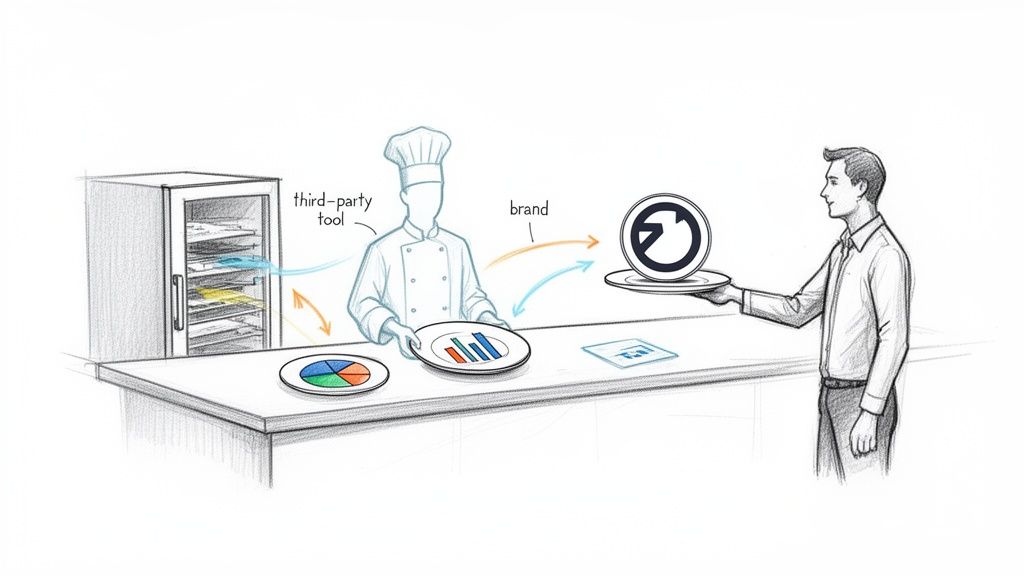
Let’s cut to the chase: white label reporting is the brilliant trick of using a third-party tool to create awesome data reports, then slapping your brand all over them. Think of it like a Michelin-star chef using a high-tech "ghost kitchen" to cook a masterpiece, then plating it on their restaurant's fancy china. It’s the ultimate power move for looking like a data god without, you know, building a data god palace from scratch.
What Is White Label Reporting Anyway?
If you've ever vaporized an afternoon wrestling with spreadsheets, copy-pasting charts until your eyes bleed, and desperately trying to make a PowerPoint look less like a hostage note, you get the problem. Manual reporting is a soul-crushing time-vampire. It scales about as well as a lemonade stand in a hurricane.
White label reporting flips the script entirely. It’s a system where some clever software (the ghost kitchen) does all the grunt work—pulling data, crunching numbers, and making it all look pretty.
Your only job? Add your branding—logo, colors, maybe a witty comment or two—and present it to your clients as your own genius work. They get a gorgeous, insightful report that screams "I'm worth every penny," and you get your sanity back. Everybody wins.
The Grind Versus The Dream
Let’s be real, the difference is like choosing between crawling to the moon and taking a rocket ship. One is a heroic, painful slog, and the other is just… smarter. This isn't just about saving a few minutes; it's a total vibe shift for your business.
The big idea is simple: You deliver pro-level, consistent reports that beef up your brand identity with every email, but without the headache of actually building them.
This approach is becoming the new normal for agencies that want to grow without drowning in admin. In fact, research shows that agencies making the switch see up to 40% faster report delivery, letting them handle more clients without hiring more people. This efficiency boost saves an average of 15-20 hours per client every month on manual reporting. You can dig into these white label industry trends on DataInsightsMarket.com.
To put it in perspective, let's look at the brutal contrast between the old way and the new way.
Manual Reporting Versus White Label Reporting At a Glance
| Aspect | Manual Reporting (The Grind) | White Label Reporting (The Dream) |
|---|---|---|
| Time Investment | Hours per client. Every. Single. Time. | Minutes to set up, then it's automatic. |
| Branding | Inconsistent. Depends on who’s having a good day. | Always on-brand with your logo and colors. |
| Scalability | Awful. More clients = more late nights. | Effortless. Add a new client in minutes. |
| Data Accuracy | High risk of human error (the dreaded copy-paste typo). | Data pulled straight from the source. Super reliable. |
| Client Experience | Often a clunky PDF or a spreadsheet nightmare. | A clean, professional report in their inbox. |
| Your Sanity | Fraying at the edges. Questioning life choices. | Calm, cool, and collected. Maybe even smug. |
The table really says it all. One path leads to burnout, the other to brunch.
How Does This Actually Work?
It's way simpler than it sounds. A good white label reporting tool connects directly to all the platforms you're already using, like Google Analytics, Facebook Ads, or your favorite SEO gizmo.
Here’s the basic flow:
- Connect Your Sources: You link your client's accounts to the platform once. That’s it. One and done.
- Build a Template: You design a report template with your agency's logo, colors, and the key metrics your client actually cares about.
- Set and Forget: You schedule the report to be sent out automatically—daily, weekly, or monthly. Then you go make a coffee.
Platforms like MetricsWatch take this even further by delivering these branded reports right into your clients' inboxes. No messy PDFs or confusing dashboard logins. Just clean, clear data that makes you look like a total rockstar.
The Undeniable Perks of White Labeling Your Reports
So, why bother with white label reporting? Is it really just about making your charts look pretty?
Nope. Not even close.
That’s like calling a Ferrari a "red car." The benefits cut straight to your bottom line, your team's happiness, and your clients' loyalty.
Let's dig into the four real-world advantages that will make you wonder how you ever survived the old way.
Reclaim Your Time and Sanity
Remember that Friday night you spent pulling data by hand? Copying charts, triple-checking numbers, and praying you didn't miss something huge? That's time you'll never get back. Manual reporting is a notorious productivity black hole.
A white label reporting platform automates that whole circus. Instead of wrestling with spreadsheets for hours, your top analyst can get back to what they're paid for—finding brilliant insights and cooking up killer client strategies.
This isn't just about saving a few hours. It’s about putting your best players on the field instead of having them stuck on the bench doing paperwork.
Scale Your Agency Without Breaking a Sweat
Picture this: you've just doubled your client roster. Amazing, right? Now, picture doubling the hours your team spends on manual reporting. Yikes. The old-school approach just doesn't scale. It's a bottleneck where growth leads directly to burnout.
White label reporting shatters that cycle. Onboarding a new client becomes a matter of a few clicks, not a week of frantic setup. You can take on more business without piling on more admin work, letting you grow your agency profitably.
It’s the difference between building a sandcastle with a tiny plastic shovel and calling in a construction crew. You can learn more about the specific benefits of scheduling your reports on the MetricsWatch blog.
Look Like a Data Genius
First impressions matter. So do the thirty-first ones. A clunky, generic-looking report doesn't exactly scream "expert." It whispers, "we threw this together five minutes before the deadline."
A consistently branded, professional report turns a routine update into a power move. It subtly reinforces your agency’s value and professionalism every single time.
This is your chance to look like the data-driven powerhouse you really are. With white label reporting, every chart, metric, and summary is presented cleanly under your brand. It builds authority and trust, making clients feel like they hired the smartest people in the room.
Make Clients Stick Around
Happy clients are paying clients. And what makes them happy? Clarity, consistency, and proof that you’re worth the money. White label reports deliver on all three.
When you send regular, easy-to-digest updates branded as your own, you keep clients in the loop and constantly prove your worth. That kind of transparency is client-retention gold.
The global white label SEO market is exploding for this exact reason. Some reports show agencies see a 28% average revenue uplift because branded reports build trust without ever revealing third-party tools. Since 2021, adoption has skyrocketed by 150%, with 82% of users reporting higher client satisfaction scores after making the switch. You can dive into more details on white label market trends on MarketResearch.com.
Ultimately, white label reporting isn't just a tool; it's a client retention machine. With a platform like MetricsWatch, you can automate this entire process and keep your agency top-of-mind.
How to Choose Your White Label Reporting Platform
Okay, you're sold. But a quick Google search reveals a zillion tools all promising to be your agency's new best friend. How do you pick the right one without getting lost in a sea of buzzwords?
Choosing a white-label reporting platform is like picking a getaway car. You need something fast, reliable, and that doesn't draw the wrong kind of attention. It just has to work.
Let's pop the hood and see what really matters.
Don't Skimp on Customization
This is the whole point, right? If you can't make the report look and feel like it came straight from your team, you might as well send a generic spreadsheet. True white-labeling is about more than just sticking your logo in the corner.
Look for a platform that offers deep customization:
- Your Logo and Colors: This is a deal-breaker. The platform should let you use your brand's exact hex codes for perfect consistency.
- Your Domain: The best tools let you host reports on your own domain, creating a seamless experience for clients.
- Custom Templates: You need to be able to build and save report templates that focus on the KPIs each client actually cares about. One size never fits all.
When choosing a platform, look for advanced integrations like a robust company styleguide api to ensure your reports perfectly align with each client's brand guidelines. This level of detail makes you look incredibly polished.
Check for the Right Connections
A reporting tool is useless if it can't talk to the platforms you actually use. Before you fall in love with a slick interface, make a list of your must-have data sources. This includes everything from Google Analytics and Search Console to social media ad platforms and SEO tools.
The platform should offer direct, stable integrations that are easy to set up. You don't want to spend your days troubleshooting broken connections. The goal is automation, not a new part-time IT job.
Insist on "Set-It-and-Forget-It" Automation
Manual scheduling is so 2010. The magic of a great white-label reporting platform is its automation. You should be able to set up a delivery schedule once and then trust the system to do its thing flawlessly.
The core value is simple: The tool should do the boring work so you can do the smart work. If you're still manually clicking "send" every Monday, you've chosen the wrong platform.
This automation is also a huge money-maker. By 2026, white-label SaaS strategies are projected to deliver 20-25% profit margins for resellers, with reporting modules being the highest-margin feature at 35%. Some studies show freelance analysts who use these tools can bill 40% more hours for strategy, while enterprises can slash reporting overhead by 60%.
Make Sure It's Not Rocket Science
Finally, the user interface (UI) matters. A lot. If the platform is so complicated it requires a PhD and a three-day training seminar, run for the hills.
The best tools are intuitive and built for busy marketers, not engineers. For example, a platform like MetricsWatch prides itself on a five-minute setup. That’s the kind of user-friendliness you should be looking for.
After all, a tool that saves you time on reporting shouldn't cost you that same time in setup. By understanding the key differences between white-label vs. branded reporting, you can better evaluate which platform is right for you.
Ready to streamline your reporting?
MetricsWatch pulls twelve sources into one white-label report, delivered on your schedule: Google Analytics, Google Ads, Google Search Console, Google Business Profile, Google Sheets, Microsoft Advertising, Facebook Ads, Facebook Pages, Instagram, LinkedIn Ads, LinkedIn Pages, and Mailchimp. Starts at $49/month. 14-day free trial, no credit card required.
Putting Your White Label Reports Into Action
Alright, theory is great, but let's get our hands dirty. You’re ready to stop drowning in spreadsheets and start dazzling clients. But where do you even start?
It’s less like building a rocket and more like assembling IKEA furniture—if the instructions were actually clear for once.
Don't worry, we’ve got the instructions. This is your simple, no-nonsense roadmap to getting your white label reporting system up and running. Think of it as your five-step plan to reclaiming your sanity.
This simple flow shows how a good tool boils it all down to a few key actions.
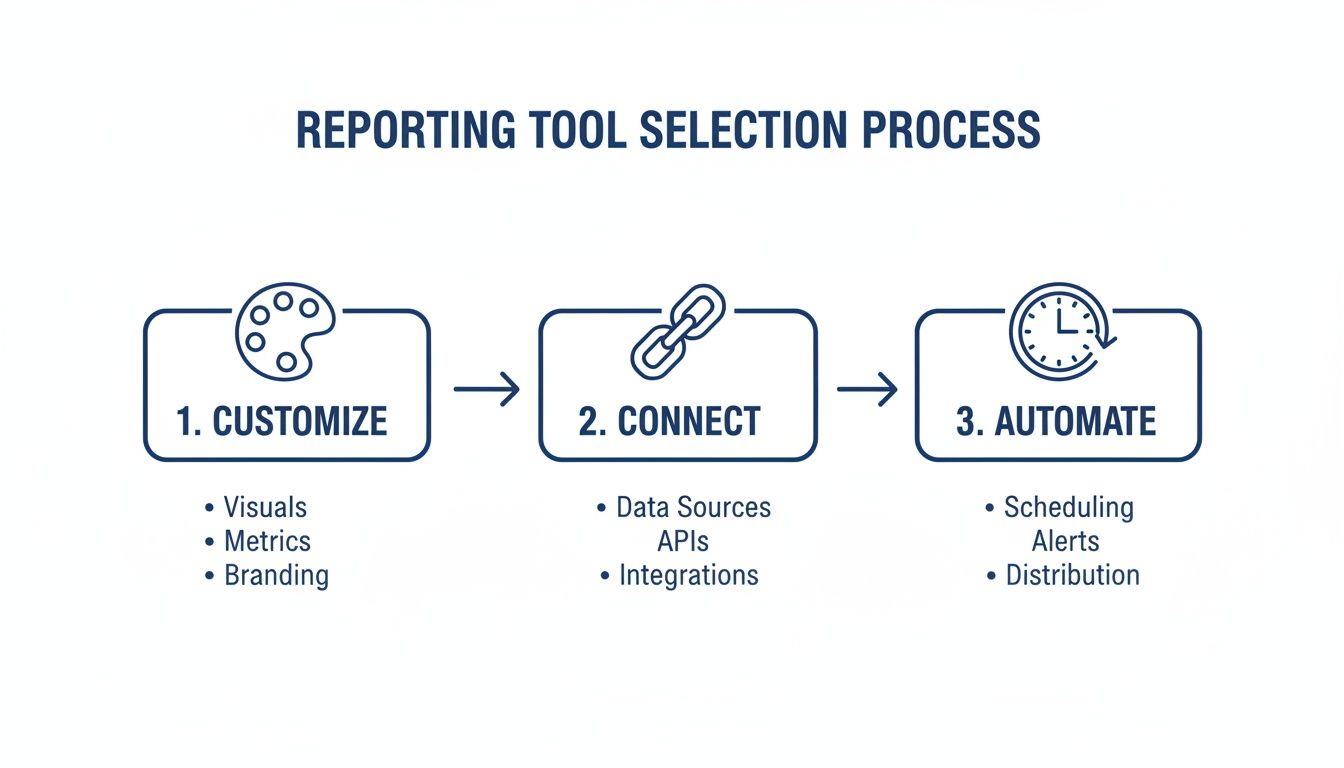
The key takeaway? The right platform turns a complicated mess into a simple sequence: customize, connect, and automate.
Step 1: Figure Out What Clients Actually Care About
Before you touch a single thing, have an honest chat with your client. What numbers actually move the needle for their business? Most clients don't care about vanity metrics like "impressions"; they care about results that impact their bottom line.
Clients don't want a data dump; they want answers. Is their investment paying off? Are more people buying their stuff? Your report should answer these questions, fast.
Focus on Key Performance Indicators (KPIs) that connect directly to their goals. For an e-commerce client, this might be Conversion Rate and Return on Ad Spend (ROAS). For a local plumber, it's probably Google Business Profile Clicks and Phone Calls. Nailing this ensures your reports are valuable, not just noise.
Step 2: Connect Your Data Sources
This is where the magic starts. A good white-label reporting tool should feel like a universal travel adapter for all your marketing platforms. Instead of logging into a dozen different dashboards, you connect them all just once.
- Google Analytics & Search Console: The bread and butter for website performance.
- Social Media Platforms: Facebook Ads, LinkedIn Ads, etc., to show campaign results.
- SEO Tools: Platforms like Ahrefs or Semrush to track rankings and backlinks.
The goal here is a drama-free connection. Platforms like MetricsWatch offer direct integrations, so you just authorize access and the data starts flowing. No wrestling with APIs or calling a developer for help. This step alone can save account managers an average of 12 hours per week on manual data gathering, according to industry surveys.
Step 3: Design Your Branded Templates
Now for the fun part: making it yours. This is where you transform a generic report into a powerful brand asset. A true white-label solution gives you total control.
You should be able to:
- Upload Your Logo: Put your agency's logo front and center.
- Set Your Brand Colors: Use your exact hex codes for headings and charts.
- Create a Layout: Drag and drop the KPIs from step one into a logical, easy-to-read story.
Once you create a template you love, you can save it and reuse it for multiple clients. A tool like MetricsWatch simplifies this, letting you build beautiful, on-brand templates in minutes.
Step 4: Put Delivery on Autopilot
Manually sending reports is a recipe for forgotten attachments and missed deadlines. The whole point of this system is automation. Set your delivery schedule once, and then sit back and let the software do the work.
Whether you need daily, weekly, or monthly updates, you can schedule them to go out like clockwork. This consistency not only makes you look incredibly reliable but also keeps clients informed without you lifting a finger. As AI evolves, you can learn more about how AI impacts white label reporting for agencies and the new automation tricks it unlocks.
Step 5: Set Clear Permissions and Access
Finally, decide who gets to see what. Not everyone on the client's team needs to see every single number. You might want a high-level summary for the CEO and a more detailed report for their marketing manager.
Good platforms let you create different report versions with specific user permissions. This ensures everyone gets the info they need without feeling overwhelmed, making your reports even more valuable.
White Label Reporting Success Stories
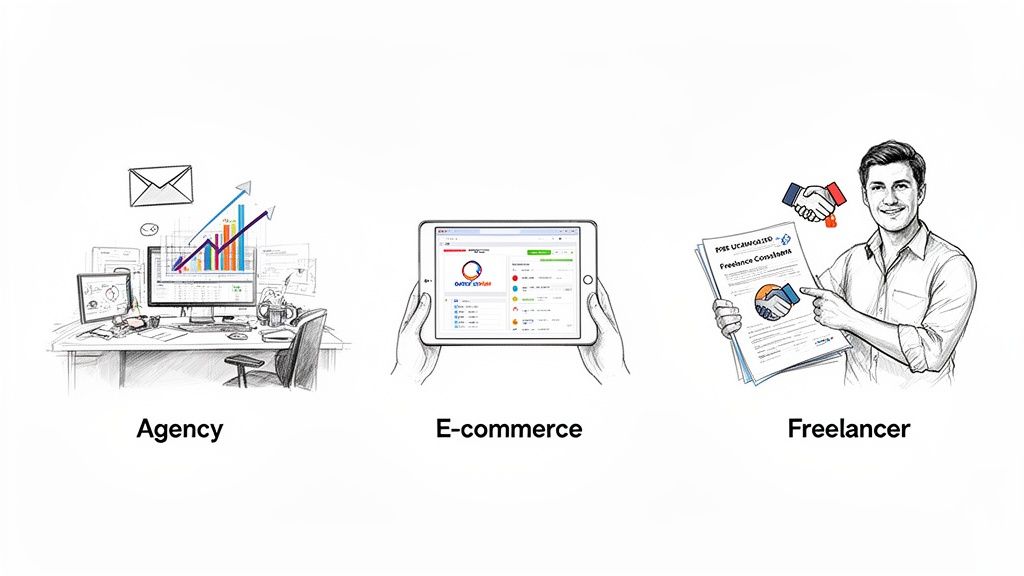
Theory is one thing, but seeing how this stuff works in the real world is where it all clicks. It’s not just about pretty charts; it’s about solving real business problems with a dose of automation and a ton of professionalism.
Let's look at a few scenarios that are probably all too familiar.
The Overwhelmed Agency Owner
Meet Sarah. She runs a great digital marketing agency, but her team was drowning in reporting. The first of every month was a frantic scramble of exporting CSVs, fighting with PowerPoint, and manually building reports for 20 different clients.
It got so bad that her account managers were spending an average of 12 hours per week just on reporting, according to their time-tracking software. That’s precious time they weren't spending on actual strategy. It was a classic growth bottleneck.
So, Sarah brought in a white label reporting tool. The change was immediate. Now, she has branded templates for each client focused on the KPIs they care about. The platform pulls all the data and sends out beautiful, on-brand reports every Monday morning like clockwork.
The result? Her team reclaimed hundreds of hours, client satisfaction soared, and Sarah could finally focus on scaling her agency.
The In-House E-Commerce Manager
Next up is Ben, an e-commerce manager for a cool shoe brand. He’s got the CEO, the head of sales, and a marketing director all wanting different updates. One wants to see ROAS, another needs top-selling products, and the CEO just wants a high-level revenue snapshot.
Ben’s week was a blur of custom reports. He felt less like a manager and more like a data-fetching robot.
He needed a way to keep everyone in the loop without being the single point of failure for all data requests. His goal was to empower people, not just answer their questions.
Using a white label reporting dashboard, Ben created a single, branded "mission control" dashboard. He then customized different views for each stakeholder, giving them real-time access to the metrics they needed. The daily email summaries, branded with the company logo, kept everyone on the same page.
Suddenly, those endless meetings turned into quick, productive check-ins. The execs felt more informed, and Ben was freed up to actually do his job.
The Ambitious Freelance SEO Consultant
Finally, let’s talk about Maria, a freelance SEO consultant who is an absolute wizard at her craft. Her challenge wasn’t getting results; it was looking as professional as the big agencies. Sending clients a jumble of screenshots just wasn't cutting it.
She knew that to land bigger contracts, her presentation had to match her expertise. She started using a white label reporting tool to deliver polished, branded weekly progress reports.
Instantly, her one-person show looked like a sophisticated firm. Her reports, complete with her logo and insightful commentary, clearly showed the value she was providing. Clients were blown away.
This professional sheen gave her the confidence to raise her rates. She landed a major contract with a client who later told her, "Your reporting was just so much clearer than the other proposals." For Maria, white label reporting became her secret weapon.
Platforms like MetricsWatch are the unsung heroes in these stories, providing the automated, brandable engine that lets businesses of all sizes prove their value effortlessly.
Common Reporting Mistakes You Can Easily Avoid
Let's be real, we’ve all been there. You spend hours crafting the "perfect" report, hit send, and then… crickets. Or worse, you get a reply from a very confused client.
Even the sharpest agencies mess up reporting sometimes. The good news? The most common fails are also the easiest to fix. Let's walk through the classics and how to sidestep them.
The Overwhelming Data Dump
This is mistake number one: burying your client under a mountain of numbers. You think you're being thorough by sending a 30-page report filled with every metric known to man.
In reality, you're just creating confusion. Clients don't want a data dump; they want clear answers. Research from organizations like the Content Marketing Institute often highlights that a lack of clarity is one of the top reasons clients get frustrated with agency reports.
Pro Tip: Stick to the Key Performance Indicators (KPIs) that directly tie back to their business goals. Less is almost always more.
The Silent Report
Picture this: a client opens your email, and all they find is a report with charts but zero context. No summary, no insights, no "what's next." It’s like being handed a map without a destination.
This forces the client to interpret the data themselves, which is the very thing they hired you to do. Sending data without insights isn't delivering value; it's just sending homework.
A report without context is just noise. Your real value isn't in providing the data; it's in explaining what the data means.
Pro Tip: Always lead with a short, plain-English summary. Explain the wins, the challenges, and what you’re doing next. That's where you shine.
The Dreaded Expectation Gap
This blunder happens way before you build the report. You assume the client cares about organic traffic, but they're laser-focused on lead conversion rates.
The result is a report that, while accurate, completely misses the mark. This gap between what you report and what the client actually cares about is a fast track to a very awkward conversation.
Pro Tip: Kick off every engagement with a reporting alignment session. Ask them point-blank: "What three numbers matter most to your business right now?" Then, build your entire white label reporting template around those answers. This one simple step will save you countless headaches.
Got a few questions still rattling around? Good. Let's tackle some of the most common ones we hear.
Is This Going to Break My Budget?
That’s the big question, isn't it? The short answer: almost certainly not. Most platforms have scalable pricing, but the real way to look at it is through Return on Investment (ROI).
Think about this: if your team is sinking even 10 hours a week into manual reporting, a good white-label tool that automates that mess costs a tiny fraction of what you're paying in salary for those hours. The time you get back makes it a total no-brainer.
Do I Need to Be a Tech Wizard to Set This Up?
Heck no. If you can log into your social media accounts, you have all the tech skills you need. The best platforms are built for marketers, not developers.
They're designed with drag-and-drop builders and simple, one-click connections. The whole point is to rescue you from technical headaches, not create new ones. A good tool should have you building your first branded report in minutes.
Can I Use This for More Than Just Analytics?
Yes, and this is where it gets really interesting. While analytics reporting is the most common use, the white-label world is way bigger. Many agencies now offer a full suite of services under their own brand, all powered by third-party tools.
This could look like:
- SEO Audits: Generating and branding technical site audits.
- Social Media Management: Offering scheduling and management through a rebranded platform.
- PPC Campaign Dashboards: Giving clients a branded portal to check on their ad performance.
White-label reporting is often the gateway drug to a much more efficient and scalable business model.
Is My Client's Data Safe?
This is a critical question. Protecting your client's data is everything. Any reputable white-label reporting provider invests heavily in security to keep sensitive information locked down.
When you're shopping around, look for providers who are upfront about their security protocols, data encryption, and privacy policies. Stick with established, well-reviewed companies that treat data integrity like the top priority it is. Your clients' trust is your most valuable asset—partner with a tool that gets that.
Ready to stop wrestling with spreadsheets and start sending reports that actually impress people? MetricsWatch makes it ridiculously easy to automate your client reporting with beautiful, fully branded reports delivered straight to their inbox. Try MetricsWatch for free today!


